

Jennifer L.
Founder & Designer at Lunis

Your portfolio is your first impression and often the deciding factor for hiring managers and clients. If you want to land the best opportunities, it needs to make an impact quickly.
1. Your First Case Study Matters the Most
Most visitors will only click on your most prominent case study, so make sure it highlights your strongest skills.
Before choosing which project to lead with, clarify your goals. What kind of role or client are you targeting? Then pick a case study that signals the right things:
Targeting fintech companies? Lead with a project that simplifies complex data into clean, usable interfaces.
Want to work with early-stage startups? Feature a project where you owned the full design process from research to shipped product.
Applying to B2B SaaS? Show how you improved onboarding conversion, not how many screens you designed.
2. Prioritize Visual Appeal
Good visuals alone don't equal great design, but a portfolio with unpolished or cluttered presentation gets overlooked fast.
This doesn't mean wrapping every mockup in a 3D device render. It means being intentional: consistent spacing, a type scale you stick with, high-resolution screenshots cropped with care instead of raw exports with browser chrome still visible. A simple gut check: if you wouldn't ship a UI that looks like your portfolio layout, redesign it.

3. Your Portfolio UX Matters
If your site is confusing or slow, people leave before seeing your projects. For UX and web designers, this is especially critical because your portfolio itself is an example of your work.
Common mistakes to avoid:
Navigation that hides your work behind hover states or scroll-triggered reveals
Heavy animations that make the site laggy on a laptop
Long single-page layouts with no way to jump between projects
Keep it simple. A clear project grid, fast page loads, and obvious navigation will always outperform a portfolio that prioritizes novelty over usability.
4. Keep Your Case Studies Focused
On average, hiring managers spend less than 55 seconds scanning a portfolio. Your case studies need to be scannable.
Skip the filler: the sticky note wall photo, the generic empathy map, the "we brainstormed as a team" paragraph. These don't differentiate you.
Instead, focus on moments where you made a design decision and why. For example: "The original checkout flow had 5 steps. I consolidated it to 3 by combining shipping and payment, which reduced drop-off by 18%." That one sentence says more than a full page of process documentation.
Structure each case study around three things: what the problem was, what you did, and what changed.
5. Highlight Measurable Impact
Numbers speak louder than words. Instead of vague descriptions, be specific:
Vague: "I created a new landing page."
Specific: "Designed a landing page that increased trial signups by 34% over 8 weeks."
If you don't have hard metrics, use proxy signals: "Shipped to 12,000 users with no negative feedback in two weeks" or "Adopted as the default template across 3 product teams." Even qualitative results work: "The VP of Product called it the cleanest onboarding flow we've shipped."

Final Thoughts
A great portfolio isn't about showcasing everything you've ever worked on. It's about presenting your best work in a clear, professional, and visually compelling way. Focus on strong visuals, a clear structure, and an intuitive experience, and you'll create a portfolio that stands out.
Looking for a starting point? Check out Velora, a free Framer template built for design portfolios.
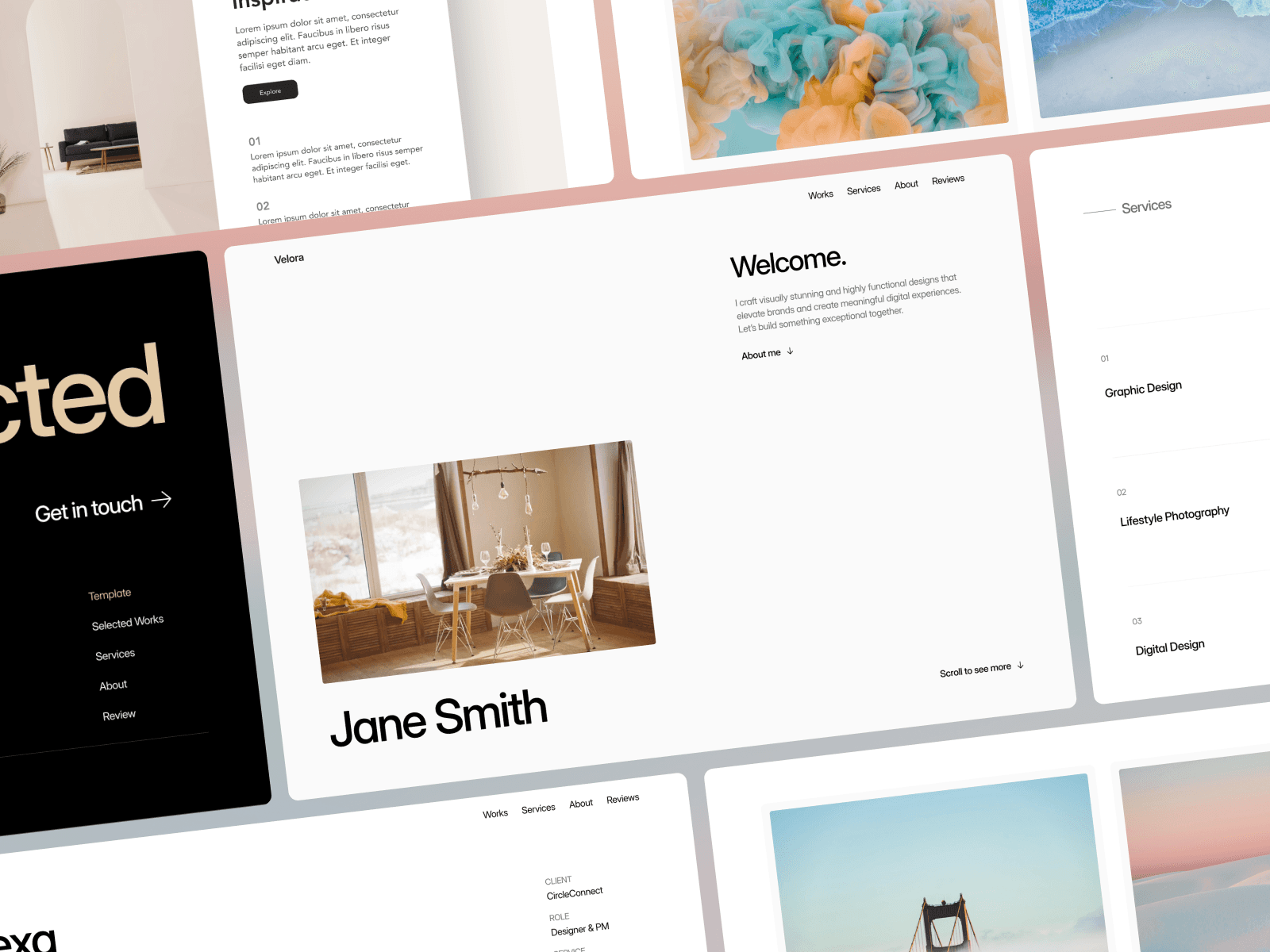
Swap in your logo, colors, fonts, and content. No code needed.